
In TripWorks, what a team member can do is controlled by permissions. You don't assign permissions to people one by one — you bundle them into a permission group and assign the group to each team member. A team member can only do what the permissions in their groups allow, and permissions are additive: someone in two groups gets the combined set. There's no "deny" permission that takes access away.
In this article
- What a team member sees without a permission
- How do I let someone do a specific thing?
- Trips & Bookings
- Catalog & Availability
- Payments & Refunds
- Customers
- Calendar, Manifest & Calls
- Reports
- Setup & Configuration
- Affiliates & Partners
- Waivers
- Users & Security
- Things that aren't controlled by a permission
- Frequently asked questions
The tables below explain what each permission actually unlocks, grouped by area, so you can build groups that grant exactly the right access. To put them to work, see Permission groups and Add & manage team members.
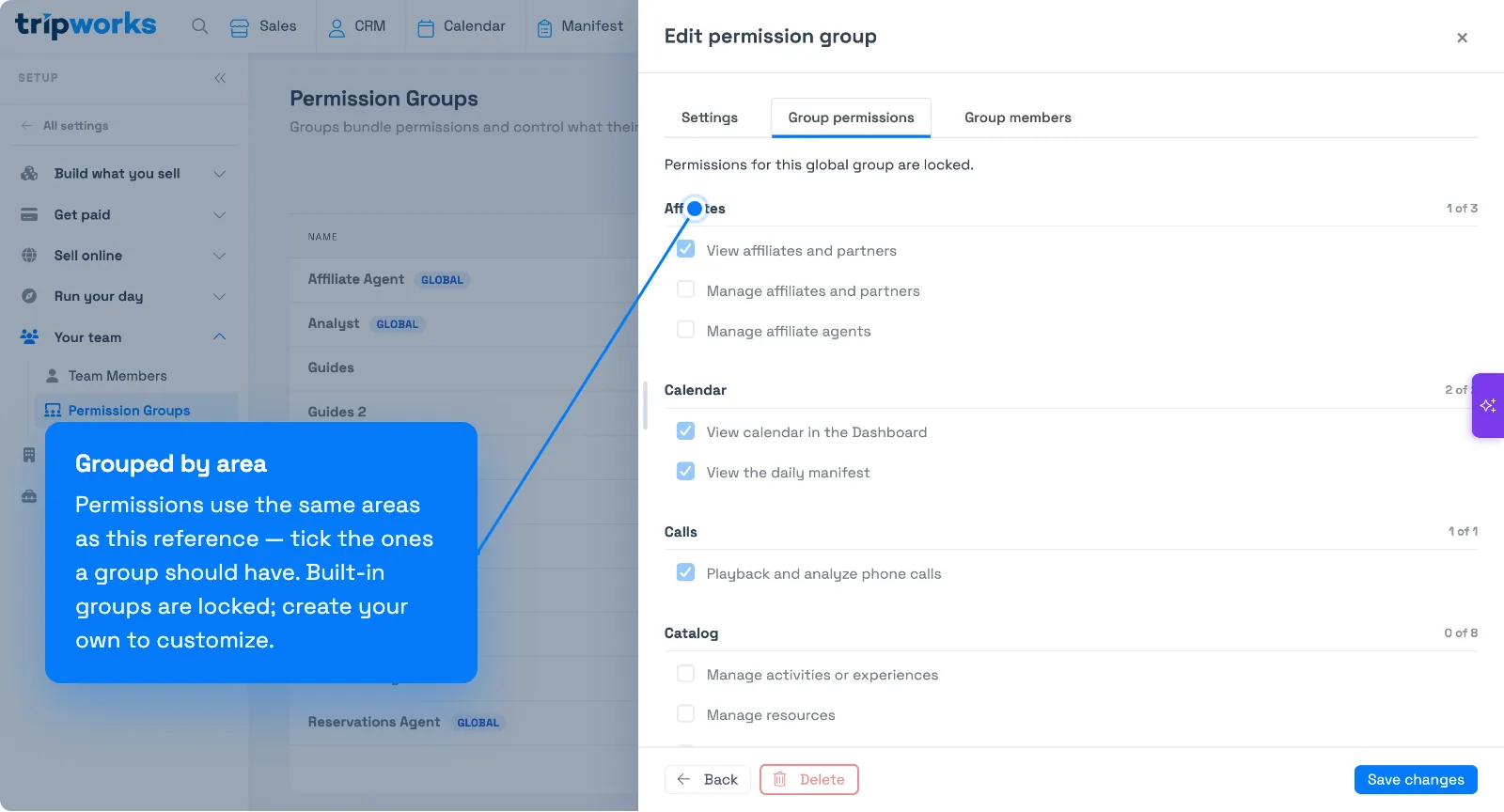
You set all of this under Setup → Your team → Permission Groups: each group bundles a set of permissions, and you assign team members to groups.
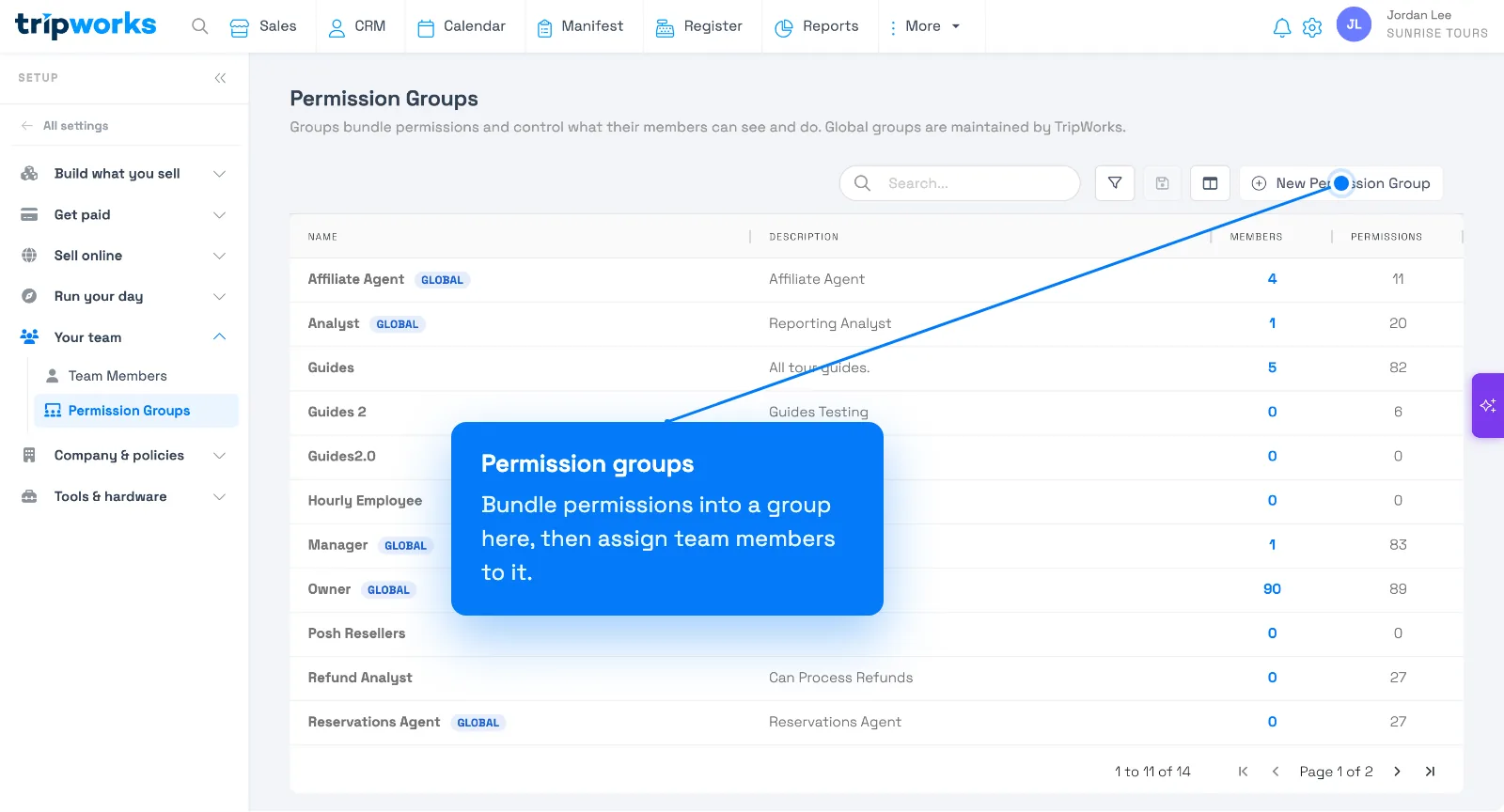
The built-in Guide and Guide Manager groups cover the two common guide roles. A guide in Guide sees only their own trips. Guide Manager sees every trip and runs the schedule. See Limit what a guide can see.
Start from the least access that lets someone do their job, then add more. View Trips and View reports module are the "front doors" — most other permissions in those areas only do something when the user can also view.
What a team member sees without a permission
Permissions apply the same way on every screen: the Manifest, the trip page, check-in, payments, the Calendar, menus, search, and exports. A button that a team member's permissions don't cover is either hidden or greyed out, with a short line underneath that says what's needed, such as "You need booking edit permission to do this." If someone opens a page they can't use, they see a No access page instead of a broken screen.
So when a teammate asks where a button went, check their permission group first. A few things that work this way:
- Check in and No Show on the Manifest and the trip page need Edit bookings on trips. Without it, the buttons are greyed out and the reason shows under them.
- Taking a payment needs Charge credit cards.
- Prices, payments, totals, and balances on the Manifest need View Trips. Without it, the Manifest still lists guests, just without the money.
- The Manifest opens with View the daily manifest. View calendar in the Dashboard opens the Calendar only.
- Signing a waiver or marking it signed for a guest needs Edit bookings on trips.
- The Waivers list opens with View signed waivers on its own.
- Adding a trip note needs Add comments to Trips or Change existing trips. Without either, the note box is greyed out.
- Adding or removing products on a trip needs Create new trips (while building a booking) or Change existing trips (on a booked trip).

The built-in Analyst group is a good example. Analysts can open the Manifest and trips to look things up, and actions their group doesn't include, like checking guests in or signing waivers, show greyed out with the reason.
How do I let someone do a specific thing?
Most permission questions start as "how do I let someone do X?" Find the task here, then read the full description in the tables below.
| You want to let someone… | Grant this permission |
|---|---|
| See the booking calendar (view only) | View calendar in the Dashboard |
| Open or close a timeslot | Manage availabilities on experiences, plus View calendar in the Dashboard to reach it |
| Cancel a timeslot | Change existing trips or Manage availabilities on experiences |
| Change a timeslot's capacity | Manage availabilities on experiences |
| Assign guides to a timeslot | Manage availabilities on experiences |
| Check guests in on the Manifest | Edit bookings on trips, plus View the daily manifest |
| Edit an activity and its settings | Manage activities or experiences |
| Rebook or reschedule a guest | Rebook guests |
| Take a card payment | Charge credit cards |
| Give a discount | Apply manual discounts to Trips |
| Issue a refund | Refund payments back to customers |
| Reserve a trip that isn't fully paid | Allow underpaid/unpaid Trips to be Reserved |
| Unlock a locked trip to edit it | Allow trips to be unlocked |
| See Finance reports | View reports module |
| Add, edit, or remove team members | Create and manage other users |
| Create or change permission groups | Manage user permission groups |
| Connect a card reader | Setup card readers for credit card payments |
| View signed waivers, or build waiver templates | View signed waivers (to view) or Setup Waivers (to build) |
| Print tickets | No permission needed. See below. |
Trips & Bookings
| Permission | What it lets a user do |
|---|---|
| View Trips | Read a trip and its bookings, waivers, documents, resources, seat maps, messages, and customer info. The foundation for the Sales area — most other trip permissions only matter alongside it. |
| Create new trips | Use the "New Trip / Sale" buttons (dashboard, calendar, manifest, Quick Sale register). Adding a booking onto the trip is the next permission. |
| Create new bookings on trips | Add an experience/booking to a trip ("Add Experience"). Without it the add buttons are hidden and the request is rejected. |
| Change existing trips | The broad edit permission: contact/pickup details, documents, removing bookings, inventory, seat maps, and more. It also covers editing the customer's info on the trip and adding comments, and it lets someone cancel a timeslot (so does Manage availabilities on experiences). (Assigning guides to a timeslot is Manage availabilities on experiences.) |
| Edit bookings on trips | Modify existing bookings: booking fields, add-ons, and edits from the manifest row. It's also the permission that lets someone check guests in (or set any other booking status) on the Manifest or in the TripWorks app. Without it the status buttons are greyed out. |
| Rebook guests | The Rebook action (move a booking to another date, time, or activity). Checked on its own, so full edit rights don't include it. Only while the trip is a draft/reserved and unlocked. |
| Edit custom field values on Trips & Bookings | Answer/change your custom booking-field values on a trip. (Defining the fields is Manage custom fields & values under Setup.) |
| Add comments to Trips | Post internal notes — useful as comment-only access for staff who shouldn't fully edit. |
| Flag a trip to another Team Member | Flag a trip to a colleague (with a note) and clear it — routes a sale to someone's attention. |
| Apply offer codes to Trips | Enter and apply a promo/offer code on a trip. Hidden without it. |
| Add complimentary bookings to Trips | "Comp Guest" a booking or whole order (free), and convert comped items back to paid. Comping an order also frees its products/add-ons. Unlocked Experience trips only. |
| Override individual prices on items | Change a ticket's or order's price ("Change Ticket Price", "Change Group Price"). Experience trips only; blocked on locked trips. |
| Change Tax & Surcharge Exemption on Trips | Toggle tax/surcharge exemptions (pencil icons on each tax line). Also controls the Deposit Due override. Hidden on locked or import-review trips. |
| Change Taxes | Open the tax setup screen to create/edit tax rules. Configuration — separate from per-trip exemptions. |
| Allow underpaid/unpaid Trips to be Reserved | Move a trip to Reserved without full payment. Otherwise the Reserve button is hidden and the request is rejected. |
| Allow trips to be booked on today's past timeslots | Reveal and book earlier-today slots that already passed. Same-day only; earlier dates stay blocked. |
| Allow trips to be unlocked | Unlock a locked trip to edit it again (makes the locked badge clickable). |
| Can reserve tickets that require other ticket types | Bypass "required companion ticket" rules — e.g. book a child ticket that normally requires an adult, on its own. |
| Book without enforcing activity restrictions or group pax minimums | Book below minimum-participant or party-size rules (a warning still shows). Staff only — never reseller or customer-portal. |
Catalog & Availability
| Permission | What it lets a user do |
|---|---|
| Manage activities or experiences | The core catalog permission — the full activity editor (details, descriptions, photos, capacity, ticket types, policies, waivers) plus activity categories, pickup locations, seat maps, and the bulk timeslot creator. |
| Manage availabilities on experiences | Create, edit, cancel, and re-capacity individual timeslots, right from the calendar, manifest, dashboard, and trip builder. This is what lets someone change a slot's Capacity (see Edit capacity for a single date or multiple dates), open or close a timeslot (change its status), and assign guides to a timeslot from the Calendar or a trip. Viewing the calendar isn't enough. Changing many statuses at once from the Calendar's Status tab also needs Manage activities or experiences. It also decides whether a guide is limited: a guide whose groups don't include it sees only the trips they're assigned to. See Limit what a guide can see. |
| Manage products | The Products and Product Categories setup screens. Adding products to a trip is covered by Create new trips while booking, and Change existing trips on a booked trip. |
| Manage resources | The Resources screen (guides, vehicles, equipment) and resource-group management. |
| Manage booking restrictions | The Booking Restrictions setup screen and the per-activity restriction editor. |
Payments & Refunds
Money-handling permissions — grant these carefully.
| Permission | What it lets a user do |
|---|---|
| Charge credit cards | Take card payments (swipe, manual entry, saved card, point-of-sale). Without it those methods are hidden and charging is blocked. |
| Apply manual discounts to Trips | Override a booking's price on a trip. Without it, price fields are read-only (unless a product is separately price-editable). |
| Apply Gift Cards as payments on Trips | Show and use "redeem gift card" in the payment modal. |
| Apply vouchers as payments on Trips | Show and use the voucher entry/apply controls on a trip. |
| Refund payments back to customers | Show the refund action and allow refunds. High-trust — often limited to managers. |
Customers
| Permission | What it lets a user do |
|---|---|
| View customers in the dashboard | Open the Customers area, profiles, and history (and read a customer's message history). |
| Edit customers in the dashboard | Save changes to a customer record (create, update, delete). |
| Merge duplicate customers | Show the merge-duplicates controls on the Customers screen. |
Calendar, Manifest & Calls
| Permission | What it lets a user do |
|---|---|
| View calendar in the Dashboard | Open the booking calendar. Does not open the Manifest (that's View the daily manifest), and does not allow editing capacity, opening or closing timeslots, or assigning guides (those all need Manage availabilities on experiences). |
| View the daily manifest | Open the daily manifest for operations. To check guests in from it, the team member also needs Edit bookings on trips. |
| Playback and analyze phone calls | Open the Calls screen and see call info/links on a trip — including AI callbot calls. |
Reports
Report access is split into the permissions below.
| Permission | What it lets a user do |
|---|---|
| View reports module | The gate to the Reports area, required before the specific families do anything. It also includes the Finance reports: Payments, Payouts, Transfers, Tips, and Taxes & Surcharges. |
| View dashboard reports | The metrics dashboard (date-range picker and sales/booking widgets). Without it, a user who can still book sees a lighter task view. |
| View and run Booking, Product, and Addon reports | Activities/bookings, products, and gift-card sold/redeemed reports. |
| View and run Sales reports | The Executive Summary and the Sales family (Summary, Detail, Underpaid, by Team Member, by Method). |
| View and run Marketing reports | Conversions, Sources, Promo Codes, Voucher Redemptions, campaign/keyword reports, and Reviews. |
| View & run customer CRM reports | The Customers report family (customer/contact lists and Flags). |
| View, create & edit custom reports | The custom report builder — build and save your own reports. |
| View & run reseller reports | The Resellers family (Summary, Detail, Commissions). |
| View & run Guide and Resource reports | The Resources reports (Summary and Detail): trips, guests, and minutes for each resource. Guides appear there only if they're set up as resources. Guides assigned to timeslots from the Calendar's Guides tab aren't included in any report. |
| Access Smart Insights Dashboard | Switch the home screen to the AI Smart Insights (BI) dashboard. Also requires the Smart Insights feature enabled on your account. |
Setup & Configuration
Account-wide configuration — usually for admins/owners only.
| Permission | What it lets a user do |
|---|---|
| Manage company profile | The broadest setup permission: company profile, point-of-sale settings, ticket printing, payment settings, data import/export, the knowledge base and chatbot/callbot setup, booking widgets, e-commerce, and the customer portal. |
| Manage company locations | The Locations setup screen. |
| Manage custom fields & values | Define the custom booking fields themselves. |
| Manage offer codes | The Promo Codes screen and campaign/reseller codes (Groupon, Travelzoo, etc.). |
| Manage gift cards | Gift-card setup and designs — and the Vouchers page (voucher program + designs are enforced by this permission). |
| Manage bank accounts & payouts | Connect/configure the bank account that receives payouts. Very sensitive. |
| Manage Trip marketing sources | The "How did you hear about us?" source list. |
| Manage Email/SMS templates & workflows | CRM settings, message templates, and automation workflows. |
| Setup integrations catalog | Connect and configure third-party integrations (OTAs, tools). It's also what shows the Integrations item in the Setup menu, so a team member without it won't see Integrations there at all. |
| Manage pricing seasons | Seasonal date ranges that drive seasonal pricing. |
| Manage pricing rules, add-on pricing & product pricing | The ticket/add-on/product price tabs inside the activity editor. |
| Manage iPad & Tablet Devices | Register and manage waiver-signing devices. |
| Setup card readers for credit card payments | Pair and manage physical card readers. |
| Can setup voucher program | Shows the Vouchers link in Setup. Grant Manage gift cards alongside it — that's what unlocks the page. |
Affiliates & Partners
| Permission | What it lets a user do |
|---|---|
| View affiliates and partners | Open the Affiliates/Resellers and Invoices areas and their read screens. |
| Manage affiliates and partners | Create and edit affiliates, partners, and their invoices (viewing needs the permission above). |
Waivers
| Permission | What it lets a user do |
|---|---|
| View signed waivers | Open the Waivers list and view the waivers guests have signed. Signing a waiver for a guest, or marking it signed, needs Edit bookings on trips. |
| Setup Waivers | Create and edit waiver templates and attach them to activities. |
Users & Security
The keys to the account — grant only to trusted admins.
| Permission | What it lets a user do |
|---|---|
| Create and manage other users | Add, edit, disable, and remove team members (and the Guides management area). |
| Manage user permission groups | Create permission groups and change what each grants — i.e. control everyone's access. The most powerful permission here. |
Things that aren't controlled by a permission
Printing tickets. There's no ticket-printing permission. Once ticket printing is set up on your account (a Raw Printer Command saved under Settings, Ticket Printing, with QZ Tray running on the device), any team member who can open a reserved activity booking can print its tickets. If the Print option is missing, check the printer setup and QZ Tray rather than permissions. See Set up ticket printing with QZ Tray.
Frequently asked questions
Which permission lets staff open or close timeslots from the calendar?
Manage availabilities on experiences, along with View calendar in the Dashboard to open the calendar. That covers changing one timeslot's status from the calendar or manifest. Changing many at once from the Calendar's Status tab also needs Manage activities or experiences. Add the permissions to the team member's permission group under Setup, Your team, Permission Groups.
Which permission lets staff check guests in on the Manifest?
Edit bookings on trips, plus View the daily manifest to open the Manifest. Check-in is a change to the booking's status, so a team member who can see the Manifest but doesn't have Edit bookings on trips sees the status buttons greyed out. The same permission applies to checking in with the TripWorks app.
Which permission lets staff assign guides from the calendar?
Manage availabilities on experiences. It lets a team member add, change, and remove guide assignments on a timeslot, from the Calendar's Guides tab or from a trip. Viewing the calendar alone shows who's assigned but doesn't allow changes.
Why don't I see Integrations in my Setup menu?
Integrations only shows for team members whose permission group includes Setup integrations catalog. Ask an account admin to add that permission to your group under Setup, Your team, Permission Groups.
Related
Built for attractions, tours & activities
Give everyone exactly the access they need
See how attractions, tours, and activities control who can do what on TripWorks with granular permission groups. Book a demo and make the switch.